







Bitcoin Price Prediction 2027: Where Institutional Analysts See BTC Heading

Bitcoin’s trajectory into 2027 represents one of the most debated topics across global trading desks. Following the fourth block reward halving in April 2024 and a bull run that pushed prices to a record high near $126,000 in October 2025, the digital asset has transitioned into a mature macro financial instrument.
As the market digested post-peak corrections through mid-2026, institutional investors and Wall Street research desks shifted their focus toward the next structural inflection point. The forecast for 2027 hinges less on retail speculation and far more on global M2 money supply growth, sovereign reserve diversification, and sustained net inflows into spot Bitcoin exchange-traded funds (ETFs).
Major financial institutions and quantitative models offer a wide range of targets for 2027, with conservative estimates placing Bitcoin between $80,000 and $130,000, while bullish Wall Street desks project peaks reaching $200,000 to $300,000.
Here is an analysis of expert forecasts, structural supply mechanics, macro drivers, and downside risks framing Bitcoin’s price path for 2027.
The Post-Halving Cycle: Setting the Baseline for 2027
To understand where Bitcoin might trade in 2027, analysts look back at the historical cadence of four-year supply halving cycles. Historically, Bitcoin follows a predictable rhythm: a supply reduction event, an aggressive rally lasting 12 to 18 months, a parabolic blow-off top, a severe drawdown, and a multi-year consolidation phase preceding the next halving.
The April 2024 halving cut miner block rewards from 6.25 BTC to 3.125 BTC per block, restricting daily new supply to roughly 450 BTC. That supply squeeze laid the foundation for the late-2025 surge. However, the institutionalization of the asset class via spot ETFs has softened the intensity of traditional four-year drawdown cycles.
By mid-2026, Bitcoin retraced toward the mid-$60,000 zone—a 45% to 50% pullback from its peak. Historically, bear cycles produced drawdowns of 77% to 86%. The shallower retrenchment in this cycle indicates that institutional rebalancing and corporate treasury holdings have established a higher price floor than in previous eras.
For 2027, this cycle positioning suggests Bitcoin will enter the late-stage consolidation and recovery phase of the fourth halving cycle, setting the stage for the fifth halving expected in early 2028.
Institutional Forecasts: Wall Street Consensus for 2027
Major equity research teams and quantitative funds have published formal targets for Bitcoin in 2027. While methodologies differ—ranging from ETF flow modeling to logarithmic decay channels—the consensus points toward structural growth.
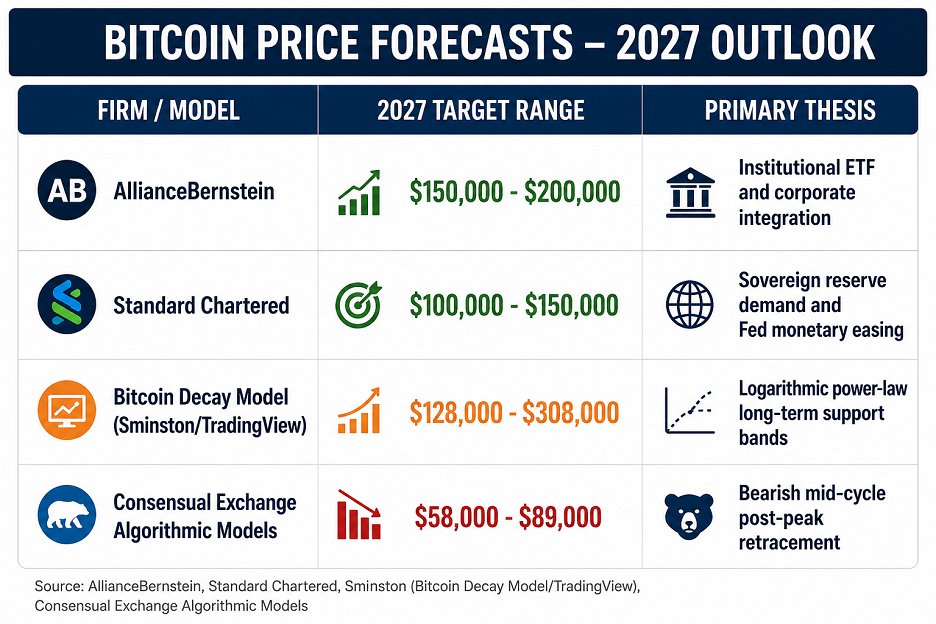
AllianceBernstein: $150,000 to $200,000 Peak Extension
Analysts at Bernstein adjusted their cycle timeline, extending their peak target into 2027. Citing slower-than-expected corporate board adoption alongside steady capital deployment from wealth management platforms into spot ETFs, Bernstein projects Bitcoin will cross $150,000 in 2026 before peaking near $200,000 in 2027. They emphasize that structural adoption by public companies building treasury reserves acts as a persistent demand sponge.
Standard Chartered: $100,000 Base Floor
Standard Chartered maintains a constructive mid-term outlook, projecting Bitcoin to stabilize around six figures into 2027. The bank’s research team points to sovereign interest and central bank balance sheet dynamics as the primary catalyst. If nation-states follow strategic reserve initiatives, the resulting floor price is expected to hold firm between $100,000 and $150,000.
Logarithmic Valuation Models: $128,000 to $308,000
Quantitative analysts tracking the “Bitcoin Decay Channel”—a logarithmic regression model that accounts for diminishing percentage returns across cycles—place the conservative valuation band for year-end 2027 between $128,000 and $308,000. Because this model measures fundamental network growth against historical bottom bands, a touch of the lower boundary in 2027 would still represent a substantial premium over previous cycle lows.
Key Macro Factors Driving Bitcoin’s Price in 2027
Sustained price momentum through 2027 depends on several structural mechanics across global finance and blockchain adoption.
1. ETF Accumulation and Wealth Management Integration
The launch of U.S. spot Bitcoin ETFs transformed market structure by opening liquidity gates for traditional capital. In earlier cycles, price surges were driven by retail leverage on offshore derivatives platforms. Today, pension funds, RIA (Registered Investment Advisor) networks, and private wealth desks allocate capital through regulated vehicles.
As these institutions implement baseline 1% to 3% strategic asset allocations within 401(k) and retirement portfolios, the cumulative net inflow creates an ongoing reduction in liquid exchange supply. By 2027, multi-year asset allocation mandates will exert compounding pressure on available market supply.
2. Global M2 Expansion and Debt Refinancing
Bitcoin historically trades as a high-beta proxy for global fiat liquidity (M2 money supply). Major sovereign debt maturities scheduled between 2026 and 2028 will force central banks, including the Federal Reserve and the European Central Bank, to navigate debt refinancing cycles.
Historically, when central banks ease financial conditions or expand balance sheets to manage debt service costs, scarce assets like gold and Bitcoin experience upward valuation re-ratings. Research from VanEck suggests that global monetary debasement remains the single strongest fundamental driver for Bitcoin’s long-term Compound Annual Growth Rate (CAGR).
3. Corporate Treasury and Sovereign Reserve Allocations
MicroStrategy’s long-standing strategy of issuing convertible debt to purchase Bitcoin established a corporate playbook that dozens of public firms now replicate. Furthermore, discussions surrounding national “Strategic Bitcoin Reserves” have moved from fringe policy proposals to active legislative debates in several jurisdictions.
Even modest purchasing allocations by small sovereign funds or municipal treasuries would absorb thousands of coins from secondary markets, exacerbating the supply deficit created by the 2024 halving.
Bull Case vs. Bear Case for 2027
Given the inherent volatility of digital asset markets, analysts evaluate multiple probabilistic outcomes for 2027.
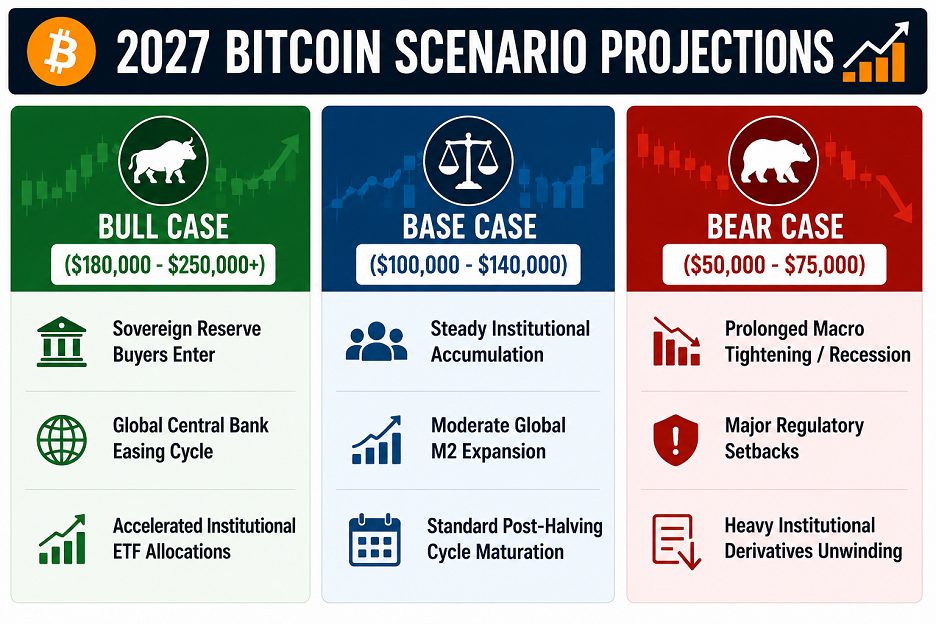
The Bull Case ($180,000 – $250,000+)
In the optimistic scenario, global monetary easing accelerates in response to sovereign debt pressures. Spot ETF monthly net inflows re-accelerate, and at least two G20 nations or major sovereign wealth funds announce official Bitcoin treasury reserves.
Supply on central exchanges drops to multi-year lows, causing a liquidity squeeze that drives price discovery above $200,000 during the second half of 2027.
The Base Case ($100,000 – $140,000)
In the baseline scenario, Bitcoin tracks its historical logarithmic decay trajectory. Institutional adoption proceeds at a measured pace through standard portfolio rebalancing. Macroeconomic conditions remain neutral, with modest rate cuts supporting risk assets.
Bitcoin reclaims its 2025 all-time high, consolidating firmly between $100,000 and $140,000 as traders position for the 2028 halving.
The Bear Case ($50,000 – $75,000)
In the pessimistic scenario, persistent global inflation keeps central bank interest rates higher for longer, suppressing liquidity across risk assets. Regulatory friction in key financial hubs restricts institutional access, or a major geopolitical shock triggers deleveraging across global markets.
Bitcoin trades down to test long-term moving averages around $50,000 to $65,000 before finding structural floor support from long-term holders.
Downside Risks and Market Bottlenecks
While long-term structural tailwinds remain compelling, several risks could cap Bitcoin’s growth in 2027:
-
Regulatory Restraints: Unfavorable tax policy shifts, restrictive capital controls, or stringent compliance mandates targeting decentralized finance ramps could slow institutional participation.
-
Macroeconomic Contraction: A global economic recession accompanied by credit market tightness typically forces funds to sell liquid assets to meet cash redemptions, temporarily suppressing Bitcoin prices regardless of network fundamentals.
-
Leverage Cascades: The growing dominance of institutional futures and options markets means market downturns can be amplified by mechanical deleveraging events.
-
Mining Economics and Network Security: Decreasing block rewards require miners to rely increasingly on transaction fees. If fee revenue remains stagnant, unprofitable miners may be forced to liquidate coin inventories, adding sell pressure.
Frequently Asked Questions (FAQ)
What is the expert price prediction for Bitcoin in 2027?
Institutional forecasts for 2027 range from a conservative base range of $80,000 to $130,000 to bullish Wall Street targets of $150,000 to $200,000+. Analysts emphasize that exact targets depend heavily on macro liquidity conditions and institutional adoption velocity.
How does the 2024 halving impact Bitcoin in 2027?
The April 2024 halving reduced daily supply emission by 50%. Historically, the compounding effect of reduced supply against constant or growing market demand manifests over a 2- to 3-year horizon. By 2027, the cumulative reduction in new coin creation will continue to exert structural upward pressure on price.
Could Bitcoin reach $250,000 by 2027?
Yes, according to several quantitative models, such as the upper bands of the Bitcoin Decay Channel and bullish Wall Street extension forecasts. Achieving this level would require strong macro liquidity expansion, sustained spot ETF inflows, and potential sovereign reserve buying.
Will Bitcoin drop significantly before 2027?
Bitcoin remains an asset characterized by 40% to 70% annualized volatility. Mid-cycle corrections of 30% to 50% are normal during post-peak phases. However, institutional inflows and corporate treasury holdings have historically established higher support levels than in earlier retail-dominated cycles.
Why is 2027 considered a critical year for Bitcoin?
The year 2027 marks the transition phase between the fourth halving cycle (2024) and the fifth halving cycle expected in 2028. It provides a key look into whether institutional spot ETFs and corporate holdings have fundamentally altered the asset’s traditional four-year boom-and-bust cycle.
Conclusion
Bitcoin’s price outlook for 2027 reflects an asset class maturing from an emerging speculative token into an established global macro reserve asset. While market cycles will continue to bring sharp volatility and periodic retracements, the structural dynamics—restricted supply emissions, regulated spot ETF channels, and expanding global money supply—point toward sustained multi-year growth.
Whether Bitcoin consolidates near $100,000 or breaks out toward $200,000 in 2027, institutional capital deployment and global macroeconomic policy will remain the defining forces steering its trajectory.
About The Author