







Bitcoin Whales Accumulate $1.5B as 10,000+ BTC Wallets Hit Six-Month High

The number of Bitcoin addresses holding at least 10,000 BTC rose to 90 this week, marking a six-month high, according to on-chain data from analytics platform Santiment. The accumulation metric signals that large entity holders are expanding their positions despite broader market consolidation and weakening retail involvement.
The count of these large addresses, often categorized as institutional holders or megawhales, has increased by six—or 7.1%—over the past eight weeks. Concurrently, intermediate and whale-tier wallets holding between 10 BTC and 10,000 BTC have added roughly $1.5 billion worth of Bitcoin to their balance sheets since late July.
This concentration of supply among larger balance addresses coincides with a contraction in balances across smaller, retail-tier wallets holding under 10 BTC. Historically, divergent accumulation patterns—where high-net-worth investors buy while retail holdings decline—have preceded significant macro price expansions.
On-Chain Supply Dynamics Shift to Institutional Hands
Data published by Glassnode and verified by market intelligence firms shows that the net flow of coins onto centralized cryptocurrency exchanges has turned consistently negative over the past fortnight. When coins move off exchanges into non-custodial or cold-storage wallets, it reduces the immediate liquid supply available for trading on order books.
The accumulation trend began accelerating during the final week of July, when Bitcoin traded within a range of $64,000 to $66,000. While short-term traders took profits or exited positions amid regulatory uncertainties and macroeconomic headwinds, large entities absorbed secondary-market liquidity.
In total, wallets holding between 10 BTC and 10,000 BTC accumulated more than 20,000 BTC over 10 days. This aggressive positioning has shifted an increasing share of the circulating supply into long-term illiquid hands.
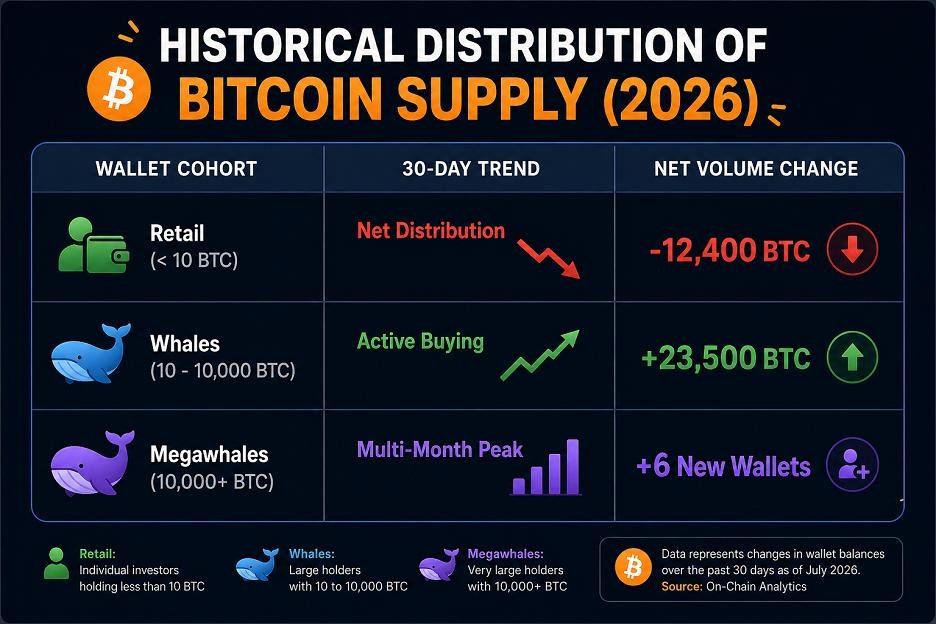
An analysis of transaction patterns reveals that much of the new volume originates from institutional custody solutions, spot ETF reserve custodians, and corporate treasuries rather than active algorithmic trading desks.
ETF Inflows and Spot Liquidity Support Price Floors
Institutional appetite has been further evidenced by activity within U.S.-listed spot Bitcoin ETFs. Market data tracking spot products recorded over $750 million in weekly net inflows during early August, reflecting sustained demand from institutional allocators.
Asset managers such as BlackRock and Fidelity reported zero outflow days across several consecutive sessions, indicating that institutional investors are holding positions rather than trading short-term swings.
Market liquidity indicators from CoinGlass show that derivative open interest has remained stable at approximately $32 billion. Funding rates across major derivatives venues—including Binance, OKX, and Bybit—have stayed neutral to slightly positive, confirming that the current spot buying is not driven by excessive leveraged speculation.
When spot purchases lead market price recovery rather than derivative leverage, the underlying market structure generally exhibits lower systemic volatility and reduced risk of cascading liquidations.
Retail Pullback Driven by Regulatory Delays and Exploits
While institutional entities expand their exposure, retail market participation has softened. On-chain metrics track a multi-week decline in the total number of active daily addresses on the Bitcoin network, dropping from peak averages seen earlier in the year.
Industry analysts attribute retail hesitation to several factors:
-
Regulatory Delays: Prolonged legislative discussions in Washington surrounding crypto market structure bills have created short-term policy uncertainty for domestic traders.
-
Security Events: High-profile hardware wallet security alerts and infrastructure exploit reports earlier in the summer led some self-custody retail holders to consolidate or liquidate balances.
-
Macro Risk Off: Fluctuating expectations regarding Federal Reserve interest rate policy have kept retail capital cautious, with funds shifting toward fixed-income and traditional money market yield assets.
This retail exit provided the liquidity required for larger entities to build positions without forcing immediate upward slippage across exchange order books.
Technical Outlook: The $70,000 Resistance Threshold
From a technical perspective, Bitcoin has consolidated in a symmetrical triangle pattern between $62,000 and $68,000. Chartists and quantitative analysts regard the $70,000 level as a pivotal resistance region.
A sustained close above $70,000 would clear the upper boundary of the consolidation channel established during the summer months. Conversely, primary support remains anchored near $60,000, where large whale clusters previously executed high-volume limit order bids.
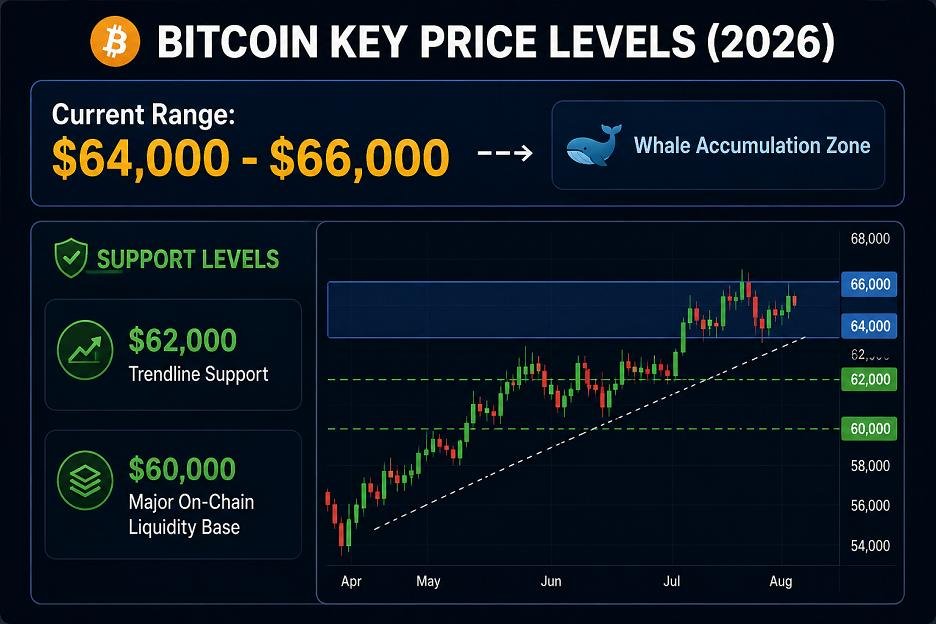
Market structure data indicates that order book depth on the ask side between $68,000 and $70,000 has thinned significantly over the last 72 hours. If institutional accumulation continues at its current rate, available sell liquidity in that range could be absorbed quickly.
Industry Commentary: Long-Term Holding Thesis Intact
Financial executives and on-chain researchers view the rise in 10,000+ BTC wallets as a reaffirmation of Bitcoin’s role as an institutional macro asset.
In a market update, Bitwise Chief Investment Officer Matt Hougan emphasized that the market structure has matured past previous cyclical sell-offs. “Institutional allocation model frameworks now routinely accommodate 4% to 5% allocations to digital assets,” Hougan noted, citing growing macro portfolio integration among private wealth offices and pension funds.
Furthermore, research teams at Binance Research pointed out that coins aged over one year have reached an all-time high percentage of total circulating supply, demonstrating that coins moved into non-custodial storage during this accumulation phase are unlikely to re-enter circulation in the immediate term.
Frequently Asked Questions
What defines a Bitcoin whale?
A Bitcoin whale is typically defined as a single entity or address holding at least 1,000 BTC. Wallets holding 10,000 BTC or more are often classified as megawhales, representing institutional funds, cryptocurrency exchanges, custody providers, or sovereign entities.
Why is the rise in 10,000+ BTC wallets significant?
An increase in wallets holding 10,000+ BTC indicates that the largest market participants are accumulating asset supply. Because these entities control large volumes of capital, their buying behavior reduces liquid market supply and often signals strong institutional confidence in future price appreciation.
How does whale accumulation affect retail investors?
When whales accumulate during periods of price consolidation, they absorb sell pressure from retail traders. This transfer of supply from short-term holders to long-term institutional holders stabilizes order books and reduces the likelihood of steep downward price moves.
How is on-chain whale data tracked?
On-chain analytics platforms like Santiment, Glassnode, Arkham Intelligence, and Dune Analytics monitor public blockchain ledgers. They group related wallet addresses using heuristic algorithms to measure holding distributions, exchange flows, and transaction volumes.
Does wallet accumulation guarantee an immediate price increase?
No. While whale accumulation is a structurally bullish signal, price movements depend on broader market dynamics, including macroeconomic conditions, spot exchange demand, derivative leverage, and geopolitical events. Accumulation shows positioning over weeks or months rather than immediate short-term price spikes.
Are all 10,000+ BTC wallets owned by private individuals?
No. Many wallets holding over 10,000 BTC belong to centralized exchanges (like Binance or Coinbase), institutional custodians, ETF custodians (such as Coinbase Custody), or wrapped token smart contracts. Analytics providers filter known exchange cold wallets to measure true private entity accumulation.
Key Takeaways
-
Six-Month High: Wallets holding 10,000 BTC or more climbed to 90, reflecting a 7.1% increase over eight weeks.
-
$1.5 Billion Inflow: Intermediate whale tiers (10 to 10,000 BTC) accumulated roughly $1.5 billion in Bitcoin since late July.
-
Retail Divergence: Balances in smaller retail wallets (<10 BTC) declined as smaller investors sold into short-term choppy market conditions.
-
ETF Support: Spot Bitcoin ETFs saw positive momentum with over $750 million in weekly net inflows, complementing spot exchange accumulation.
-
Key Technical Threshold: Quantitative market metrics point to $70,000 as the critical overhead resistance level for the next macro expansion phase.
About The Author