







Institutional Stablecoins Reshape Global Payments Infrastructure as Market Cap Tops $320 Billion

NEW YORK — Corporate adoption and regulatory clarity have propelled the global stablecoin market past $320 billion in total circulating supply, fundamentally transforming cross-border settlement rails and enterprise payment stacks. Annual transaction volumes reached $33 trillion in 2025 and continue to expand in 2026, driven by mainstream financial institutions integrating fiat-backed digital dollars into settlement engines.
According to data compiled by DefiLlama, total dollar-pegged stablecoin supply crossed $321 billion this year, marking a 50% year-over-year expansion. The shift reflects a migration from speculative trading collateral toward core commercial payment infrastructure.
Corporate Giants Build Direct Settlement Rails
The balance of power within payment networks is shifting as major financial platforms directly integrate stablecoin rails. Payment processors Visa and Mastercard have embedded USDC settlement into their merchant networks, while Interactive Brokers launched direct account funding via stablecoins in partnership with Zero Hash.
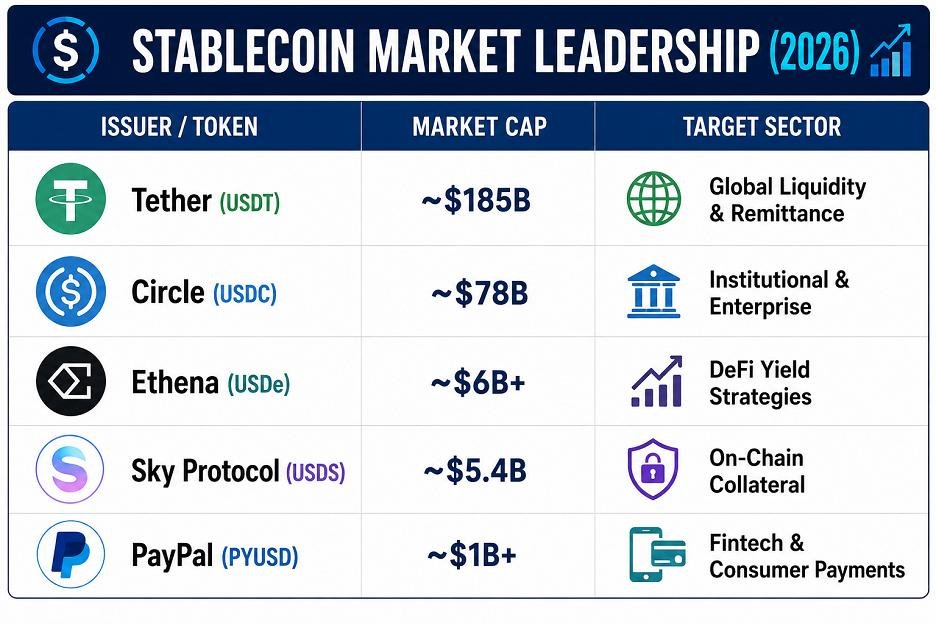
Tether (USDT) maintains its dominant position with roughly $185 billion in circulation, representing approximately 58% of global market share. Its volume remains heavily concentrated in high-liquidity emerging market trade corridors and energy settlements.
Meanwhile, Circle’s USD Coin (USDC) has cemented its status as the institutional default for compliance-focused enterprises. Circulating supply for USDC reached $78 billion, with quarterly processed volume on the network topping $11.9 trillion.
Regulatory Frameworks Accelerate Wall Street Adoption
The surge in institutional adoption follows major regulatory developments in primary markets. In the United States, enactment of the Guiding and Establishing National Innovation for US Stablecoins (GENIUS) Act established strict requirements for 1:1 reserve backing with cash and short-term U.S. Treasuries, bankruptcy-remote custody structures, and monthly public attestations.
In Europe, the full implementation of the Markets in Crypto-Assets (MiCA) regulation has forced non-compliant issuers out of the single market while providing licensed operators access to 27 member states.
“Regulatory certainty eliminated the primary headline risk that kept corporate treasurers on the sidelines,” said Chiara Munaretto, Managing Partner at Stablecoin Insider. “Stablecoins are no longer viewed as a speculative crypto-native asset, but as programmable digital cash with yield and instant settlement advantages over legacy correspondent banking.”
Data from the Federal Reserve indicates stablecoin issuers collectively hold more short-term U.S. Treasury bills than many sovereign nations, injecting hundreds of billions into federal debt markets.
B2B Cross-Border Payments Drive Growth
Commercial entities are increasingly bypassing traditional SWIFT banking rails to avoid correspondent fees and settlement delays. According to a report by Astute Analytica, corporate B2B cross-border payments processed via stablecoins exceeded $2 trillion annually, with monthly transaction volumes averaging over $4 trillion.
Large corporate transfers, which historically incurred fees of up to several thousand dollars alongside multi-day clearing times, now settle on-chain in seconds for less than $1 in network gas fees.
New entrants continue to challenge the incumbents. Ripple’s fiat-backed RLUSD and PayPal’s PYUSD have expanded their presence across Layer-1 and Layer-2 blockchains such as Solana, Base, and XRP Ledger, targeting commercial treasury workflows and micro-payments.
While Tether and Circle combined command over 80% of total supply, competition among secondary issuers is intensifying around fee models, yield pass-through mechanics, and multi-chain interoperability.
Key Takeaways
-
$320B Market Cap: Aggregate dollar-backed stablecoin supply reached a record high exceeding $321 billion.
-
$33 Trillion Processed: Annual stablecoin transaction volume matched major traditional card and wire networks.
-
Market Concentration: Tether (USDT) and Circle (USDC) control over 80% of circulating supply.
-
Institutional Drivers: Enactment of the GENIUS Act in the U.S. and MiCA compliance in Europe provided the regulatory foundation for enterprise deployment.
About The Author